
Rainwater drainage is the least visible building system and the one that, when poorly sized or poorly executed, causes the most damage to a building. Wall infiltration, render delamination, facade staining and the accelerated degradation of window frames originate, in most cases, from undersized gutters, badly soldered joints or poorly positioned downpipes.
ZincArt designs, fabricates and installs drainage systems in zinc-titanium and copper for roofs of any size, from a detached house to industrial roofing. We work on new build and on the replacement of old systems at the end of their life, with in-house fabrication of pieces in our workshop and installation carried out by our team.
What a complete drainage system comprises
A zinc drainage system is not just the gutter visible at the eaves. It comprises a coordinated set of elements:
- Gutters collecting the water running off the roof.
- Valley gutters recessed into roofs with a parapet or with concealed drainage design.
- Downpipes carrying the water to ground level or to the building's drainage network.
- Hoppers connecting the gutter and the downpipe, with the appropriate dimensional transition.
- Flashings at chimneys, parapets, lantern roofs, ridges and dormers.
- Complementary accessories: chimney cowls, vents, leaf guards, silt boxes.
When these elements are fabricated in the same material and finish, and installed in a coordinated way, the system functions for decades without significant intervention.
Zinc gutters
The gutter is the structural element of the system. We fabricate zinc-titanium gutters in various profiles:
- Half-round — the classic, efficient profile suited to the vast majority of residential roofs.
- Rectangular or trapezoidal — a contemporary profile, with a more geometric reading, suited to modern architecture.
- Moulded / with mouldings — ornamental profiles for the restoration of historic buildings, reproduced from the survey of the original pieces.
The sheet used is typically between 0.7 mm and 0.8 mm thick for standard gutters, and may rise to 1.0 mm in stretches exposed to significant loads. Gutters are supplied in lengths suited to transport and to the spacing between supports; the joints between lengths are executed by tin-lead soldering, ensuring full watertightness over the entire service life of the system.
Fixing is by means of brackets in galvanised or stainless steel bar, or by concealed supports integrated into the eaves, with spacing sized according to the profile, the regional snow load (where applicable) and the exposure.
Downpipes
Downpipes are fabricated in circular or rectangular section, with diameters suited to the drainage flow of the area served. The most common diameters are between 80 mm and 120 mm for residential use; larger projects or higher rainfall require specific sizing.
Bends, transitions, branches and inspection sockets are fabricated piece by piece, with exact angles to negotiate mouldings, balconies, cornices and other facade elements. Fixing to the wall is by means of clips in zinc or stainless steel, positioned at regular intervals depending on the height of the pipe.
Valley gutters and flashings
Valley gutters are recessed gutters, hidden behind a parapet or integrated into the roof geometry, often in contemporary architecture projects or in the restoration of older buildings. They demand greater care in execution: generous sizing to avoid overflow, impeccable soldering, and emergency overflow devices (gargoyles, overflow scuppers) to limit the risk of flooding in case of blockage.
Flashings resolve every transition in the roof: junctions with walls, chimneys, lantern roofs, dormers, skylights and parapets. Each flashing is fabricated by folding the sheet to the specific design of the point, with a lower drip and an upper tab that ensure the watertightness of the joint. The general flashing detail is one of the distinctive marks of a well-executed roof — invisible when done well, glaring when it fails.
Accessories
For a truly complete drainage system, we supply and install:
- Chimney cowls in zinc or copper, fabricated to measure for the existing or proposed crown.
- Vents and breathers for roof ventilation and waste-water networks.
- Decorative hoppers that enhance the transition between gutter and downpipe, often specified on restoration projects.
- Leaf guards and retention baskets at outlets, reducing the frequency of cleaning required.
- Inspection chambers integrated at critical points of the circuit.
In-house workshop fabrication
Our in-house fabrication capacity is a concrete differentiator for ZincArt against standardised industrial solutions. We have folding, rolling and soldering equipment that allows us to produce each piece to the exact size of the project, instead of adapting prefabricated products to contexts for which they were not designed.
The process follows an established sequence: dimensional survey on site, preparation of the technical drawing, cutting and forming of the sheet, soldering of the joints, dimensional and watertightness control, and finally transport and assembly on site. This integration enables us to respond to complex geometries, to restoration projects with irregular alignments, and to signature designs that lie outside off-the-shelf catalogues.
Materials
ZincArt drainage systems use European raw material from the leading zinc-titanium mills (VMZINC, elZinc, RHEINZINK) and rolled copper. The choice between zinc-titanium and copper depends on the context:
- Zinc-titanium — the technical reference solution. Excellent durability-to-cost ratio, stable visual integration, broad compatibility with other materials.
- Copper — the noble solution for heritage or signature projects, with characteristic chromatic evolution and longer service life.
We do not recommend mixing zinc and copper in the same drainage run, due to the galvanic corrosion that occurs when water running over copper reaches zinc surfaces downstream. Find out more about the materials we use.
Maintenance and cleaning
A well-executed zinc drainage system has minimal — but not zero — maintenance requirements. We recommend:
- Cleaning the gutters at least once a year, ideally in autumn, to remove leaves and debris.
- Visual inspection of flashings, soldered joints and downpipe clips.
- Checking the discharge points (hoppers, gargoyles, outlets) to confirm they remain unobstructed.
For buildings of difficult access or for clients who would rather delegate this routine, ZincArt provides a repair and maintenance service with scheduled technical visits.
Where we work
We install drainage systems throughout mainland Portugal, with regular presence in Lisbon, Porto, Braga, Coimbra, Aveiro, Faro, Leiria and Viseu. Drainage is often part of a wider roofing intervention — see also zinc and copper roofs.
Examples of work
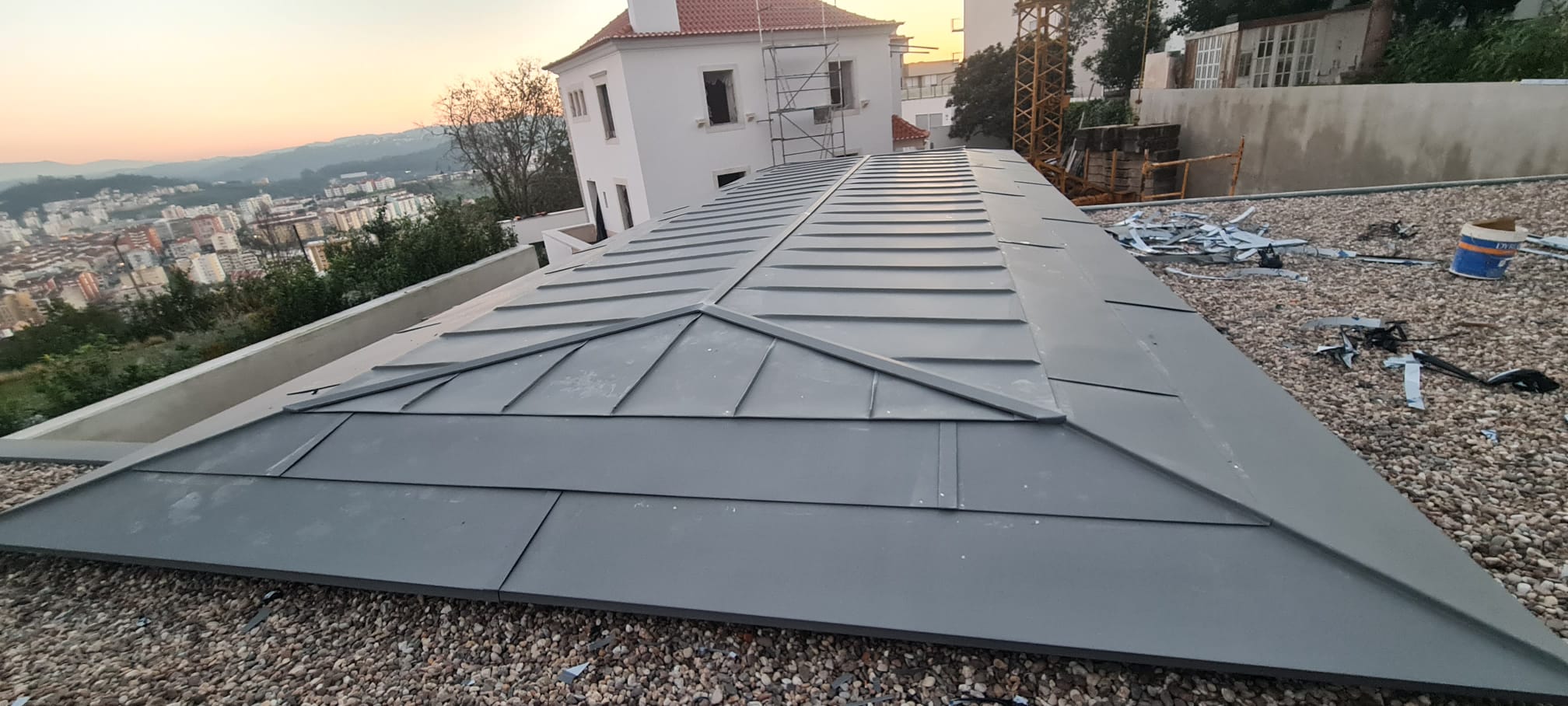
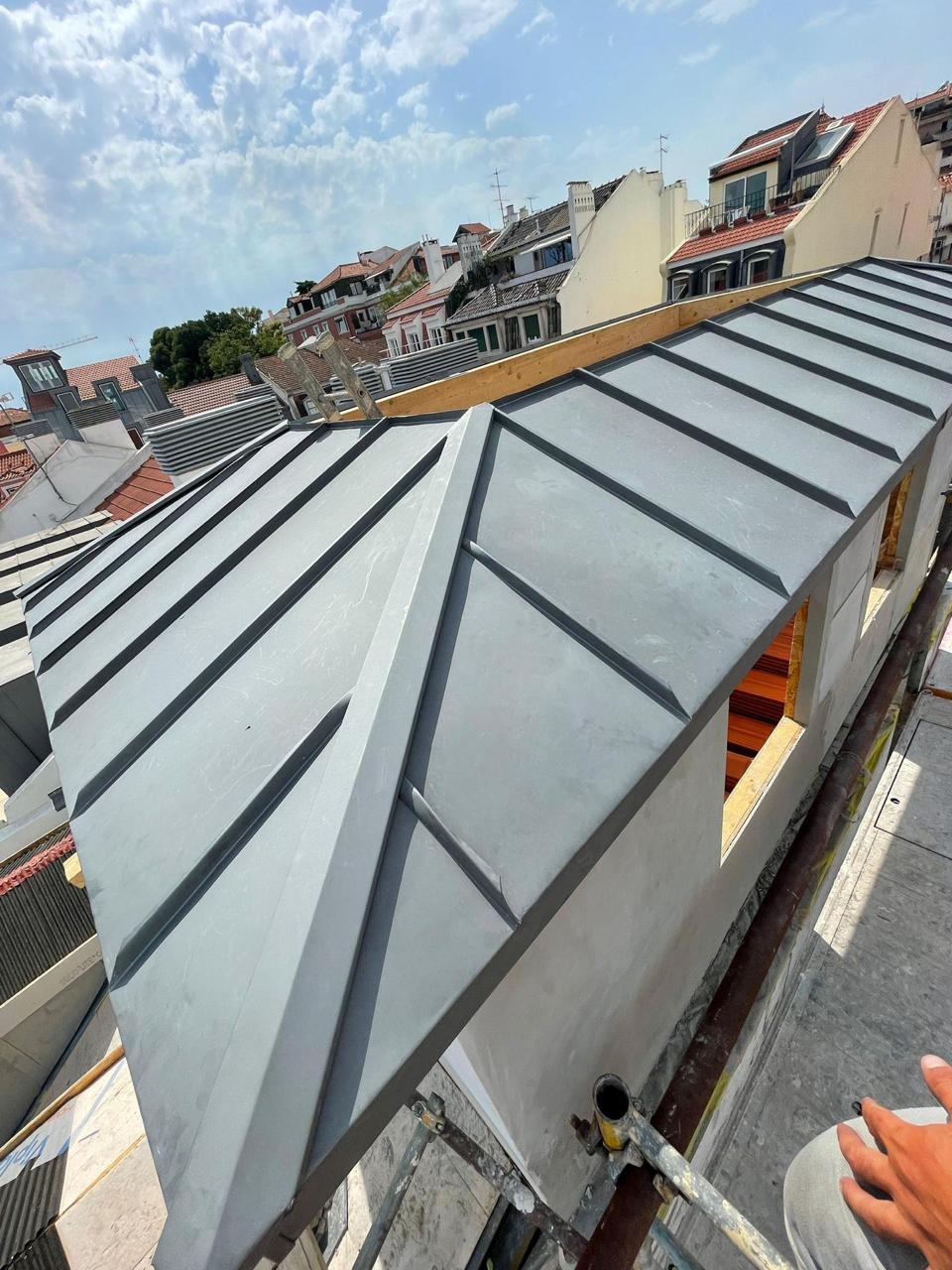
Quote request
For a proposal sized to the characteristics of your roof, contact ZincArt by phone on 935 610 516, by email at zincart.pt@gmail.com, or via the contact form. The enquiry includes a site visit and measurement of the areas to be drained.