The roof is the most exposed element of a building, and the one whose performance shapes the building's thermal behaviour, watertightness and appearance over decades. Zinc and copper roofs are a technical answer for projects in which longevity, geometric precision and architectural expression admit no compromise. We work on new build, on restoration and on one-off interventions, from housing to industrial roofing, always with zinc-titanium or copper sheet executed by specialised metalworkers.
Our team works throughout mainland Portugal, with a strong presence in the North and Centre. Every roof is studied on site before fabrication, so that the profile, thickness, seam system and ventilation can be matched to the real conditions of the substrate and the local exposure.
Standing seam system
The standing seam — also known as joint-debout in its French origin — is the reference system for continuous metal roofs. It consists of joining longitudinal bays of zinc or copper by mechanically folding the upstands, forming a double seam that closes the joint without any perforation of the sheet or chemical sealant.
From a constructional perspective, the system has three decisive advantages:
- Full watertightness. The seam sits above the water plane and does not depend on any rubber or silicone to resist driving rain and wind.
- Freedom of expansion. The bays are fixed to the substrate with concealed clips, fixed and sliding, that accommodate the metal's thermal movement without inducing stress in the sheet or audible noise.
- Suitability for low pitches. The double standing seam is compatible with low pitches (from around 5%, in line with the manufacturer's guidance), opening the door to contemporary roof geometries with very shallow falls.
The seaming is carried out on site with an electric closing machine, ensuring uniform tightness of the seam along its full length. The visual result is regular vertical lines that enhance the reading of the elevation and remain pristine through the natural ageing of the metal.
Click seam system
The click or snap-lock seam is a pre-formed evolution of the standing seam. The bays leave the factory already folded with a male-female interlocking profile that joins together by simple pressure, removing the need for the seaming machine on site.
This system is particularly suited to medium-to-high pitches (above 25% / around 14°), where speed of installation more than offsets the slight geometric limitation. The main differences compared to the traditional standing seam are:
- Faster installation, with less exposure of the interior structure to the elements during the works.
- Less reliance on specialised labour for the closing operation, although marking out, cutting and flashings still demand the same rigour.
- A final appearance very close to that of the standing seam, with the same vertical rhythm of lines, the difference being barely perceptible from street level.
The choice between standing seam and click seam is technical: it depends on pitch, bay length, wind exposure and the overall budget. On every site visit we recommend the appropriate solution based on these criteria.
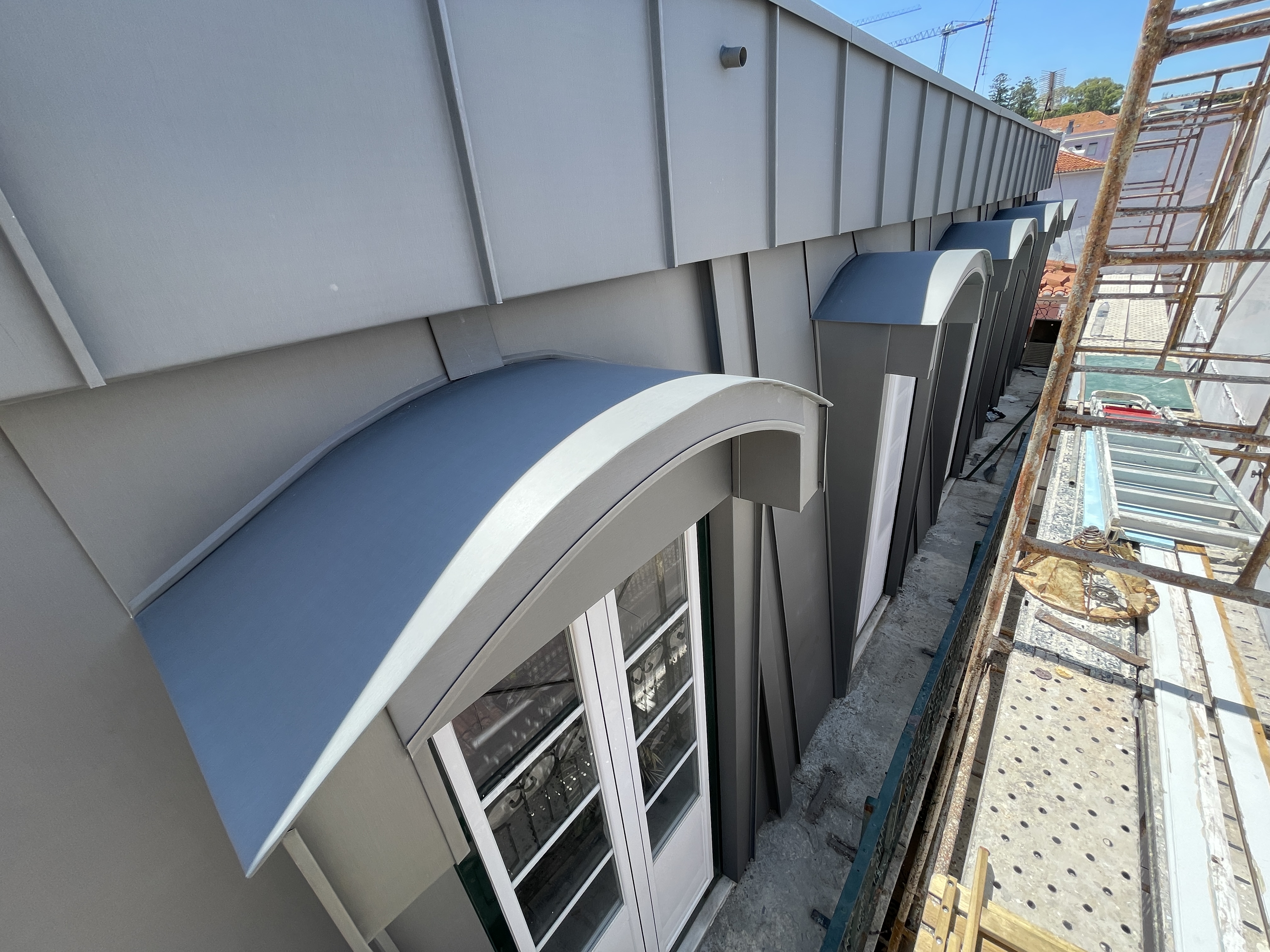
Barrel (curved) roofs
The barrel roof — camarinha in traditional Portuguese vocabulary — is the curved or vaulted roof, often associated with turrets, dormers, lantern roofs, curved porches and corner finishes in classical architecture. Executing a barrel roof in zinc or copper is one of the most demanding pieces of roofing metalwork: each bay has to be cut and shaped to follow the curvature, and the seams have to be executed in development, maintaining perfect parallelism along the radius.
ZincArt fabricates and installs barrel roofs on contemporary housing projects, on the restoration of historic buildings and on tower crowns. The preliminary design is based on the dimensional survey of the structure, and fabrication of the pieces is fully carried out in the workshop, leaving only the assembly and the closing of the seams for site.
Materials used
We work with zinc-titanium and copper sheet from the leading European mills in the sector, chosen for their metallurgical control and the traceability of their batches:
- VMZINC. QUARTZ-ZINC (light-grey pre-weathered) and ANTHRA-ZINC (dark-grey pre-weathered) finishes, as well as natural zinc and the PIGMENTO range in various colours.
- elZinc. European zinc-titanium available in natural, pre-weathered and pigmented ranges.
- RHEINZINK. Zinc-titanium with prePATINA blue-grey and graphite-grey finishes, frequently specified by architects for the uniformity of tone.
- Natural and pre-oxidised copper. For heritage and signature roofs.
All sheet is supplied with a certificate of origin and the manufacturer's technical data sheet, in accordance with EN 988, the standard applicable to rolled zinc for construction. More information at materials we use.
Components of the complete system
A metal roof does not end at the sheet plane. The durability of the assembly depends on the quality of the complementary elements, fabricated in our workshop in the same material and finish as the roof:
- Gutters (half-round, rectangular or trapezoidal), with a section sized to the area served.
- Downpipes, round or rectangular, with brackets suited to the height of the building.
- Flashings and general flashing details at the transitions with walls, parapets and chimneys.
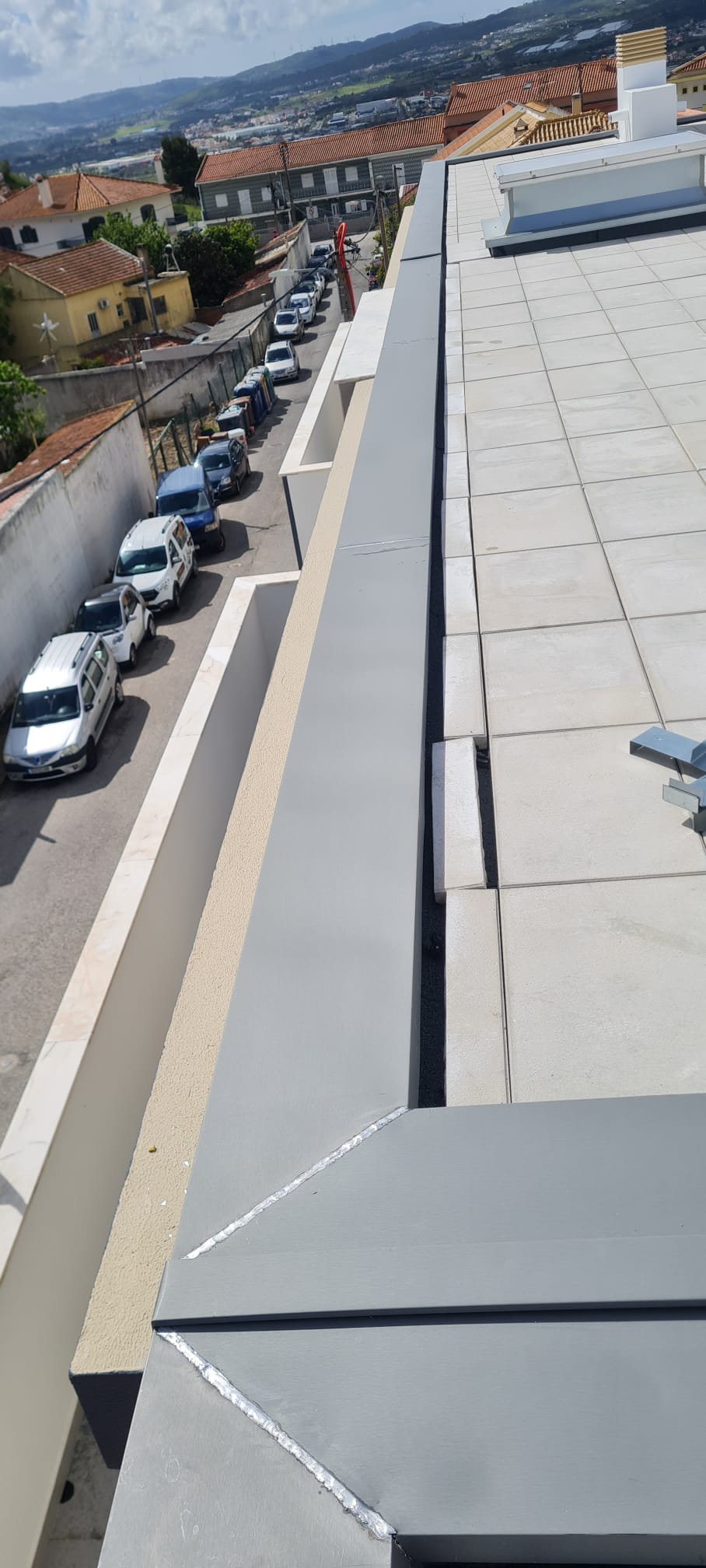
- Coping on low walls and parapets.
- Finishes at the ridge, eaves, verge and penetrations.
- Accessories such as chimney cowls, vents, skylights and lantern roofs.
Full drainage details are set out on our page about zinc drainage systems.
Durability and maintenance
The service life of a zinc-titanium roof depends mainly on the atmospheric environment. Reference values published by the European industry are around 90 to 100 years in a rural environment, 40 to 60 years in an urban environment and 30 to 40 years in an aggressive industrial environment. In coastal environments, with careful execution and adequate separation from other metals, values of 40 to 70 years are achieved.
Routine maintenance comes down to periodic cleaning of gutters, visual inspection of flashings and checking of fixing points. Zinc and copper require neither paint nor chemical treatment: the natural patina that forms on the surface is, in itself, the protective layer of the material.
Where we work
ZincArt operates throughout mainland Portugal, with its operational base in Porto. We carry out roofing in Lisbon, Porto, Braga, Coimbra, Aveiro, Faro, Leiria, Viseu and the corresponding districts. For projects outside these centres, please contact us for confirmation of timelines and logistics.
See also our portfolio of projects.
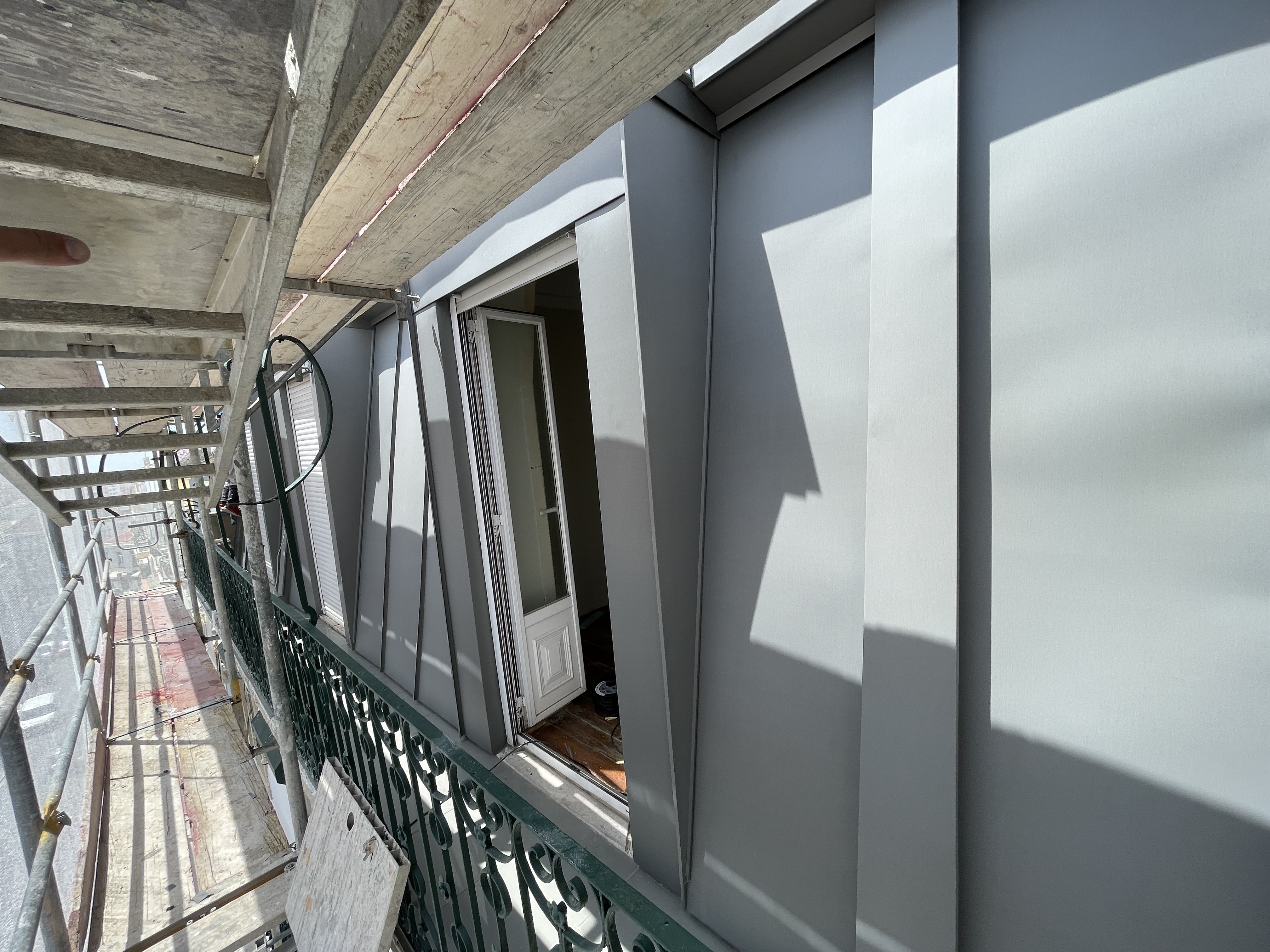
Examples of work
Frequently asked questions
From what pitch is a zinc roof feasible?
With a double standing seam system, the recommended minimum pitch is around 5% (about 3°), provided the requirements for substrate continuity and underside ventilation are met. For click seam, the practical minimum is around 25%.
Is zinc compatible with other roof materials?
Zinc must not be in direct contact with copper, nor with water that has run over copper, due to galvanic corrosion. It has good compatibility with stainless steel, anodised aluminium and neutral timbers (those not treated with aggressive salts).
What warranty do you offer on the work carried out?
We offer a written warranty of up to 10 years on installation, without prejudice to the manufacturers' specific warranties on the sheet itself, which cover the integrity of the material for their own periods.
Do you work on existing roofs or only on new build?
We work on both. On restoration work, the preliminary technical survey allows us to identify the best strategy: full replacement, overlay with a new substrate or localised repair and maintenance work.
Quote request
For a technical analysis of your roofing project, contact ZincArt by phone on 935 610 516, by email at zincart.pt@gmail.com or via our contact form. Each enquiry includes a site visit, dimensional survey and a detailed written proposal.